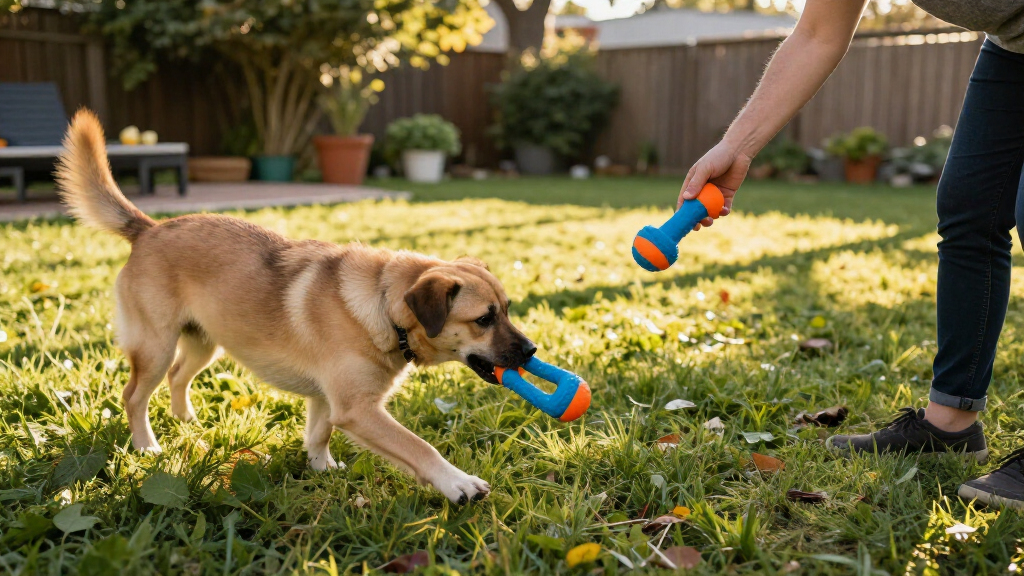

This guide shows you how to get an interactive dog toy from the package into regular, effective use. Interactive toys include treat-dispensing puzzles, snuffle mats, chew-style puzzle feeders, electronic motion toys, and hide-and-seek games. Used correctly, they drain mental energy, slow down fast eaters, reduce boredom-driven chewing and barking, and give your dog a constructive activity when you are busy. Used incorrectly, they get ignored, get destroyed, or become a choking hazard.

Get pet supplies delivered free — and shop member deals
- Fast, free delivery on millions of items
- Access to Prime Big Deal Days deals on October 6–7
- Prime Video, Amazon Music and more included

Interactive Dog Ball Toy with 3 Play Modes, Sound, Vibration, and USB-C Charging
- ✔ Toy type: Interactive ball
- ✔ Play modes: 3
- ✔ Shell material: E-TPU

Interactive Moving Dog Toy Ball with Rope
- ✔ Toy type: Moving ball with rope
- ✔ Modes: Fast, slow, and interactive
- ✔ Activation: Motion-activated

360° Rotating Tether Tug Toy for Dogs
- ✔ Toy type: Rotating tether tug
- ✔ Rotation: 360°
- ✔ Height settings: 38, 46, and 54 inches
By the end of this guide you will have selected the right toy for your dog, introduced it so your dog succeeds quickly, run a full play session, and set up a routine that keeps the toy interesting for months. The guide is written for first-time and intermediate dog owners. No special training skills are needed — only patience and consistency.
Difficulty: Beginner. Time: 20-30 minutes for setup and the first introduction, then 10-15 minutes per session going forward.
Difficulty: Beginner | Time: 20-30 minutes for setup and first introduction; 10-15 minutes per daily session
What You’ll Need
Tools & Materials:
- One or more interactive dog toys appropriate for your dog’s size and chewing style (puzzle feeder, snuffle mat, treat-dispensing ball, or electronic motion toy)
- High-value soft treats or part of your dog’s daily kibble ration (pea-sized or smaller)
- A quiet, low-distraction space with non-slip flooring (kitchen corner, living room rug, or bathroom floor)
- A towel for cleanup if you are using moist treats
- Warm water and mild dish soap, or a bottle brush, for cleaning
Knowledge:
- Knowing your dog’s weight and chew strength (gentle chewer, moderate, or power chewer)
- Basic ability to read dog body language: interest, frustration (whining, pawing repeatedly, disengaging), and stress (yawning, lip licking, avoidance)
- Awareness of any food allergies your dog has
Check every toy for a size rating before you buy. A toy rated for small breeds can lodge in a large dog’s throat, and a hard toy meant for large power chewers can crack a small dog’s teeth. If your dog has a history of destroying and swallowing toy pieces, choose durable rubber or fabric-free designs and supervise every session until you know how the dog handles the toy.
Interactive Dog Ball Toy with 3 Play Modes, Sound, Vibration, and USB-C Charging
For buyers who want one toy to deliver several kinds of stimulation, this ball makes the most balanced case in the lineup. It moves, bounces, and rolls across three play modes, adding sound, vibration, and seven LED colors to encourage attention. Compared with the rope-equipped ball, it provides more clearly specified sensory features and a shorter stated charge time; unlike the tether, it can move around rather than keeping play anchored to one spot.The 3.15-inch E-TPU shell is described as lightweight and flexible, and IP54 water resistance supports use indoors or outdoors. A roughly 50-minute USB-C charge is listed for up to 3.5 hours of play, which makes it easier to slot into a routine than a toy with a longer charging window. Still, we would treat the playtime as a stated maximum, not a guarantee for every mode or dog.This is the strongest all-around choice for dogs that chase moving objects and benefit from changing cues. Its biggest limitation is chewing: the description specifically recommends supervision, especially for aggressive chewers. Buyers looking for owner-controlled sounds may prefer the Bluetooth playback on Product 2, while dogs who thrive on tugging may get more from Product 3.
Pros:
- Three modes combine rolling, bouncing, and movement
- Sound, vibration, and seven LED colors add varied cues
- USB-C charge takes about 50 minutes; listed playtime is up to 3.5 hours
- IP54 water resistance and a flexible E-TPU shell support varied play settings
Cons:
- Supervision is recommended, especially for aggressive chewers
- Sensory cues may not suit dogs sensitive to sound, vibration, or lights
Best for: Households seeking a versatile moving ball for supervised indoor or outdoor chase play.
Not ideal for: Dogs that aggressively chew toys unsupervised, or owners who want Bluetooth audio control.
Bottom line: We rank it first for combining varied movement and sensory cues with the clearest charging and playtime details, provided play is supervised.
“We rank it first for combining varied movement and sensory cues with the clearest charging and playtime details, provided play is supervised.”
Interactive Moving Dog Toy Ball with Rope
This moving ball is the choice for buyers who want to shape the audio side of play. Along with built-in bird sounds, it offers Bluetooth audio playback, a feature the first ball does not list. Three modes—fast, slow, and interactive—give owners a way to match movement to different activity levels, and motion activation can prompt engagement without constant handling.Its stated surface compatibility spans carpet, hardwood, and tile, which makes it a practical option for indoor chase sessions across common flooring. Compared with the first ball, however, the supplied details are less specific about shell material, water resistance, and runtime. Charging takes about two hours, and the power adapter is not included; buyers should check their USB power setup before expecting to use it.The included rope offers another way to invite interaction, though the description does not specify its length or durability. This pick suits households interested in adjustable sounds and motion-triggered play. It ranks behind the first ball for all-around clarity and charging convenience, and it is a poor match for anyone who needs a toy with a stated playtime or outdoor water-resistance rating.
Pros:
- Fast, slow, and interactive modes accommodate different play intensity
- Motion activation can initiate play when the dog approaches
- Bluetooth audio playback supplements built-in bird sounds
- Listed for carpet, hardwood, and tile
Cons:
- Charging takes about two hours
- Power adapter is not included
- No playtime duration or water-resistance rating is specified
Best for: Owners who want an indoor moving ball with motion activation and the option to play Bluetooth audio.
Not ideal for: Buyers who prioritize a short charging time, specified runtime, or detailed material and water-resistance information.
Bottom line: We recommend it when sound customization is the priority, but the first ball is easier to assess for charging and sustained play.
“We recommend it when sound customization is the priority, but the first ball is easier to assess for charging and sustained play.”
360° Rotating Tether Tug Toy for Dogs
Unlike the two balls, this toy turns interactive play into a fixed outdoor tug-and-chase activity. A rotating pole, spring rebound, and three rope toys give dogs something to pull, pursue, and chew while the tether returns movement through its spring system. The three height settings—38, 46, and 54 inches—let owners adjust the setup to suit their dog more readily than a one-size ball.That distinct format is also its main constraint. The tether is designed for installation on firm, stable grass, and the description advises avoiding dry, wet, or sandy ground. Installation takes about 20 minutes, so it does not offer the immediate portability of either rechargeable ball. We would choose it when outdoor tugging is the goal and the yard has an appropriate spot, rather than as a general indoor interactive toy.Compared with the balls, this model encourages pulling instead of following unpredictable rolling movement, and it does not list charging, sounds, or electronic modes. That simplicity may appeal to dogs motivated by ropes, but buyers should confirm the available ground and supervise play as appropriate. Its narrow installation requirements place it third overall despite a focused play style and useful height adjustment.
Pros:
- Three rope toys support tugging, chasing, and chewing
- Three height settings accommodate different setups
- Rotating pole and spring rebound encourage solo interaction
- No charging routine is listed
Cons:
- Requires firm, stable grass for installation
- Description advises avoiding dry, wet, or sandy ground
- About 20 minutes of installation and a fixed location reduce portability
Best for: Owners with suitable grassy outdoor space whose dogs enjoy tugging, chasing, and rope play.
Not ideal for: Apartment dwellers, households without firm stable grass, or buyers seeking a portable electronic toy.
Bottom line: We place it third because it offers a focused outdoor tug experience, but its ground and installation requirements make it less broadly usable than the balls.
“We place it third because it offers a focused outdoor tug experience, but its ground and installation requirements make it less broadly usable than the balls.”
As an Amazon Associate we earn from qualifying purchases.
Before You Start
Do three things before the first session. First, inspect the toy: pull at seams, check that treat openings are the right difficulty (food should fall out when you test it by hand at the easiest setting), and remove any tags, plastic clips, or packaging staples. Second, measure out treats or kibble — use part of the dog’s daily food ration rather than extra calories, or you will cause weight gain within weeks. Third, pick your training window: introduce the toy when your dog is calm but awake and mildly hungry, such as mid-morning or an hour before dinner. A dog that has just eaten a full meal or is exhausted from a long walk will ignore a food puzzle.
Safety note: never leave a dog unattended with a new toy during the first several sessions, and never leave electronic toys or toys with batteries with any dog unsupervised. Batteries are toxic if chewed or swallowed.
Step-by-Step Instructions
Step 1: Set the toy to its easiest difficulty
Adjust the toy so it releases food with minimal effort. Open adjustable puzzle feeders to their widest dispensing setting, scatter treats loosely on top of snuffle mat fabric strips instead of burying them, and select the largest opening on treat balls. Then test the toy yourself: tip it or roll it by hand and confirm treats fall out easily. If they do not, loosen the setting before you bring the dog over.
Tip: The first session’s only job is to teach the dog that this object gives food. Difficulty can be increased later; start easy enough that the dog wins within seconds.
Check: When you roll or tip the toy by hand, food falls out with almost no resistance.
Step 2: Introduce the toy in a quiet space
Bring your dog to the low-distraction area you prepared. Sit or crouch near the toy, place it on the floor, and drop two or three treats directly next to it while your dog watches. Allow the dog to approach and investigate on its own. Do not push the toy toward the dog, hold it in the dog’s face, or drag it around to force interest — this commonly makes cautious dogs back off.
Tip: Turn off the TV, keep other pets in another room, and avoid talking to the dog. Silence lets the dog focus on the problem in front of it.
Check: Your dog approaches the toy within 30-60 seconds and sniffs, paws, or nudges it.
Step 3: Watch the dog solve it and hold back from helping
Stand or sit back and let the dog work the toy without interference. Allow 2-3 minutes of effort. Watch for progress: nosing, pawing, tipping, and rolling are all correct attempts. Step in only if the dog shows clear frustration — whining, repeated frantic pawing, walking away and lying down, or ignoring the toy for more than about 30 seconds after engaging. If that happens, tap the toy once so a treat falls out, then let the dog continue.
Tip: Helping too quickly is the most common mistake owners make. A little struggle is the point — that effort is the mental workout. Assist only to prevent the dog from quitting.
Check: Your dog gets at least one treat out of the toy on its own and stays engaged.
Step 4: End the first session while the dog is still engaged
Stop the session after 5-10 minutes, or after the dog has retrieved a handful of treats. Pick up the toy and put it out of sight, even if the dog is still actively playing — leaving the dog wanting more makes the next session far easier. Praise calmly, then resume normal household activity.
Tip: Store the toy in a cupboard or closet, not on the floor or in the open toy basket. A toy that is always available stops being interesting within days.
Check: The dog looks toward where the toy went or follows you — mild disappointment means the toy registered as valuable.
Step 5: Run daily sessions and raise difficulty gradually
Repeat short sessions once or twice daily. Increase difficulty one notch once the dog solves the current setting in under a minute with confidence: narrow the dispensing opening, bury treats deeper in the snuffle mat, or add a step to the puzzle. Change only one variable at a time, and expect the dog to need a couple of sessions to adjust after each increase.
Tip: A good rule: if the dog solves it instantly every time, it is too easy; if it quits within a minute, it is too hard. Aim for roughly 2-5 minutes of engaged work.
Check: Over one to two weeks, your dog works the toy at progressively harder settings without losing interest.
Step 6: Rotate toys to prevent boredom
Swap each toy out for a different one after 3-4 days of use once you have two or three interactive toys. Store the unused toys fully out of sight during their off-rotation. Bring a toy back after its break and watch it generate nearly the same excitement as when it was new.
Tip: Reserve one special toy for specific situations, such as a stuffed puzzle feeder given only when you leave the house. This builds a positive association with your departures.
Check: Your dog shows renewed enthusiasm each time a rotated toy reappears instead of ignoring it.
Step 7: Clean and inspect the toys weekly
Wash treat-dispensing toys once a week in warm water with mild dish soap, using a bottle brush to reach inside chambers where food residue and bacteria build up. Rinse fully and air-dry before the next use. Shake out and spot-clean snuffle mats, and machine-wash them on a gentle cycle monthly if the label allows. While cleaning, inspect every toy for cracks, split seams, loose parts, worn fabric, or exposed edges.
Tip: Discard any toy with a crack or a piece small enough to chew off. Food residue inside puzzle toys grows mold quickly — a dog that rejects a previously loved toy is often reacting to a smell you cannot detect.
Check: Toys are free of residue, dry, structurally intact, and the dog accepts them without hesitation after cleaning.
Common Mistakes to Avoid
- Starting the toy at full difficulty — Always begin at the easiest setting so the dog succeeds within seconds. A dog that fails repeatedly at a hard puzzle learns the toy is frustrating, not rewarding, and may refuse all similar toys afterward.
- Leaving interactive toys out all the time — Store them between sessions. Constant access removes novelty, and most dogs stop engaging with a toy they can access at any moment. Rotating toys out of sight keeps them interesting for months.
- Using treats on top of the dog’s full daily food ration — Measure the toy’s contents from the dog’s daily k allowance — fill the puzzle with breakfast kibble instead of using the bowl, or use small low-calorie training treats. Uncontrolled puzzle-treat calories cause real weight gain in a matter of weeks.
- Leaving a destructive chewer unsupervised with a puzzle toy — Supervise every session until you know exactly how your dog handles each toy. Power chewers can break off rubber flaps or fabric strips; swallowed pieces can cause intestinal blockages that require surgery.
Troubleshooting
Problem: The dog completely ignores the toy
Solution: Make the toy easier and the dog hungrier. Use higher-value food (a smear of soft cheese, tiny pieces of cooked chicken), skip the hand-feeding at the next meal, and try again 30-60 minutes later. If the dog still shows no interest after three short attempts on different days, the toy type may simply not suit this dog — try a different category, such as a snuffle mat instead of a rolling ball.
Problem: The dog gets frustrated and barks, whines, or gives up fast
Solution: Drop the difficulty back one level immediately. Demonstrate once: tip the toy so a treat falls out in front of the dog, then hand it back. Keep sessions under five minutes at this stage. Frustration means the gap between skill and challenge is too wide — close it before pushing forward again.
Problem: The dog chews the toy instead of working it
Solution: Redirect: when chewing starts, take the toy, roll it so a treat falls out, and give it back. If chewing continues, switch to a more durable rubber toy with thicker walls and a simpler mechanism. Chewing puzzle toys apart is a safety issue, not a solving strategy, so supervise closely or discontinue that toy.
Problem: The dog solves the toy too fast and loses interest
Solution: Raise difficulty: tighten the dispensing opening, freeze a stuffed toy with wet food inside so it takes longer, bury treats deeper in a snuffle mat, or graduate to a multi-step puzzle. You can also split the same food amount across two different toys so the dog has to switch strategies mid-session.
What Success Looks Like
You have succeeded when: (1) your dog approaches the toy eagerly when it appears, without coaxing; (2) the dog works at the toy steadily for 5-15 minutes; (3) the dog can handle the current difficulty setting with visible effort but no quitting; (4) the toy is put away after each session and rotated with others so interest stays high; and (5) you can hand the dog a stuffed puzzle or snuffle mat before a busy period or departure and the dog settles into quiet, focused activity instead of pacing, barking, or destructive chewing.
Next Steps
Once basic puzzles are routine, expand in two directions. First, increase complexity: multi-stage puzzle boards, frozen stuffed toys that take 20+ minutes, and hide-and-seek games where you hide the toy in another room. Second, apply the toys to specific problems — give a snuffle mat before visitors arrive to keep the dog occupied, or a frozen puzzle feeder when you leave to build a calm departure routine. Reassess toy condition monthly and replace anything cracked or frayed. If your dog guards toys, freezes stiff over food, or swallows toy pieces, stop solo use and consult a certified trainer or veterinary behaviorist before continuing.
Frequently Asked Questions
How long should an interactive toy session last?
For most dogs, 10-15 minutes of focused work is equivalent to a much longer physical walk in terms of mental fatigue. For puppies and seniors, keep sessions to 5-10 minutes. End while the dog is still engaged rather than waiting for it to get bored.
Can I use interactive toys instead of a food bowl?
Yes, and for many dogs it is an improvement — it slows fast eaters and turns daily calories into mental work. Feed one meal per day from the toy, measuring the same amount you would put in the bowl. For dogs that need to eat quickly for medical reasons, check with your veterinarian first.
Are electronic interactive toys safe for unsupervised dogs?
No. Toys with batteries, motors, or small electronic parts should only be used under supervision. A determined chewer can open a battery compartment, and swallowed batteries cause serious internal injury within hours. Use durable passive toys (rubber treat holders, snuffle mats) for unsupervised time instead.
How many interactive toys does my dog need?
Two or three different types is enough for most households — for example, one rolling dispenser, one snuffle mat, and one puzzle board. Rotate them on a 3-4 day cycle so each stays novel. More toys add little benefit if they are all left available at once.
My dog destroys every toy. Are interactive toys still an option?
Often yes, with the right choices. Look for solid natural rubber puzzle toys from rugged product lines rated for power chewers, avoid fabric mats and thin plastic puzzles, and always supervise. If the dog swallows pieces, discontinue interactive toys and consult your veterinarian or a behaviorist, since destruction can also stem from unmet exercise or anxiety needs.
Fall Picks
fall essentials
As an affiliate, we earn on qualifying purchases.