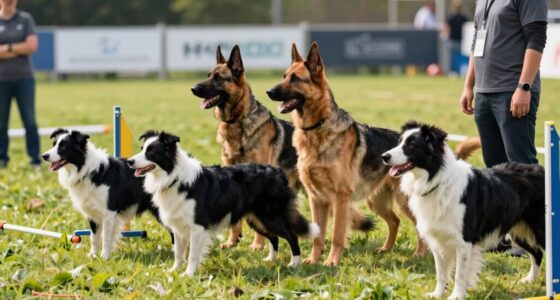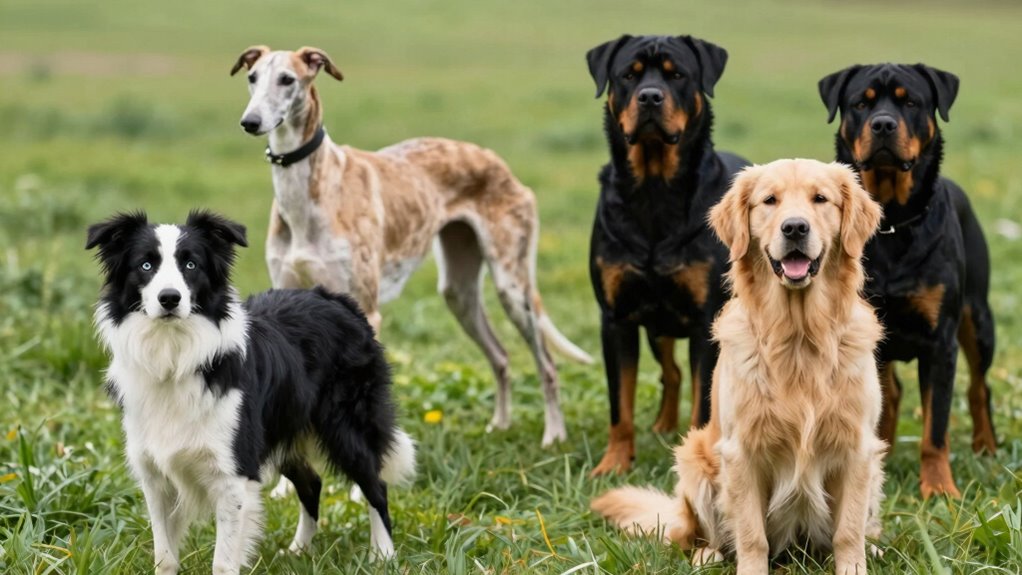

Understanding a dog’s breed purpose reveals important clues about its natural temperament. For example, herding breeds are intelligent and energetic, needing lots of mental and physical activity. Guarding breeds tend to be confident and alert, with strong territorial instincts, while hunting breeds are persistent and driven by their sense of smell. Companion breeds are usually friendly and sociable, built for family life. If you want to uncover more about your dog’s behavior cues, keep exploring these breed insights.

Get pet supplies delivered free with Prime
- Fast, free delivery on millions of items
- Prime Video, Amazon Music and more included
- Member-only deals all year
Key Takeaways
- Breed purpose influences innate behavioral traits, signaling how a dog may react in various situations.
- Herding breeds often exhibit high intelligence and energy, indicating a need for mental and physical stimulation.
- Guarding breeds tend to be territorial and alert, reflecting their historical role in protection.
- Hunting breeds show persistence and a strong sense of smell, suggesting a natural drive for tracking and retrieving.
- Companion breeds are typically sociable and affectionate, aligning with their primary role as family friends.

Ever wonder how a dog’s breed purpose influences its temperament? The answer lies in understanding the behavioral traits shaped by the breed’s historical roles. Each breed was developed with specific tasks in mind, and those origins leave lasting impressions on their personalities today. For example, breeds created for herding, like Border Collies, tend to be highly intelligent, energetic, and focused. Their behavioral traits make them excellent working dogs, but these same traits also mean they need plenty of mental and physical stimulation to stay balanced. Recognizing this connection helps you predict how a breed might behave in everyday life.
Understanding a breed’s origins helps predict their behavior and needs in everyday life.
Similarly, breeds crafted for guarding, such as Dobermans or Rottweilers, often display confidence, alertness, and territorial instincts. Their historical role as protectors influences their temperament, making them naturally cautious around strangers but loyal to their families. These behavioral traits are essential for their original purpose, but they also highlight the importance of proper training and socialization to ensure they’re friendly and well-adjusted companions. When you understand a breed’s historical role, you better grasp why they react the way they do and how to nurture their best qualities.
Hunting breeds, like Beagles and Retrievers, were bred for tracking and retrieving, which explains their keen sense of smell, persistence, and enthusiasm to work. Their behavioral traits include high energy levels and a love for activity, meaning they thrive on regular exercise and mental challenges. These traits are rooted in their purpose to assist hunters, so if you’re considering one as a pet, you should be ready to provide outlets for their natural instincts. Knowing the breed’s purpose helps you anticipate their needs and manage expectations about their behavior.
In contrast, companion breeds such as Pugs or Cavalier King Charles Spaniels were developed primarily for companionship. Their behavioral traits tend to be friendly, affectionate, and sociable, reflecting their role as family friends. Their historical roles shape their temperament in a way that makes them more adaptable to indoor living and more receptive to human interaction. Understanding these roots enables you to appreciate their gentle nature and cater to their social needs.
As an affiliate, we earn on qualifying purchases.
Frequently Asked Questions
How Do Breed Purposes Influence an Individual Dog’s Personality?
Breed purposes shape a dog’s personality through genetic predispositions, influencing traits like herding instinct or guarding tendencies. Environmental influences further mold these tendencies, enhancing or tempering natural behaviors. For example, a herding breed raised in a stimulating environment may become highly energetic and focused, while one with minimal activity might develop different traits. Understanding these factors helps you better interpret and meet your dog’s unique personality needs.
Can Breed Purpose Change Over a Dog’s Lifetime?
Breed purpose can change over a dog’s lifetime because genetics and training influences evolve. While genetic markers set a baseline for temperament, ongoing training, socialization, and environment shape behavior. You can help a dog develop new skills or adapt to different roles, but core traits rooted in breed purpose tend to remain. So, even with changes, understanding genetic and training influences helps you guide your dog’s development effectively.
Are Temperament Clues Consistent Across Different Breeds With Similar Purposes?
Around 60% of a dog’s temperament can be linked to genetic markers, which influence breed-specific traits. If you’re wondering if temperament clues are consistent across breeds with similar purposes, the answer is generally yes, but training influence plays a significant role too. While breeds with shared purposes may exhibit comparable traits, individual differences and training can modify behaviors, making consistent temperament cues a useful, but not absolute, guide.
How Accurate Are Breed Purposes in Predicting Behavior?
Breed purposes offer useful insights but aren’t entirely accurate in predicting behavior. Your dog’s genetic influence plays a role, but individual temperament varies. Training impact is significant; a well-trained dog can behave differently from its breed’s typical traits. While breed purpose helps set expectations, it’s essential to take into account personal history, environment, and training to truly understand and guide your dog’s behavior effectively.
Do Mixed Breeds Display Temperament Traits Based on Breed Purpose?
Like a tapestry woven with threads from different fabrics, mixed breeds display temperament traits shaped by crossbreeding influences, creating a vibrant spectrum of behavior. Their temperament diversity reflects the unique blend of breed purposes, sometimes revealing traits from both parent breeds or surprising you with new ones. You’ll find that these dogs often embody a mosaic of instincts, making each one a distinctive puzzle piece in the canine world.
dog training and socialization books
As an affiliate, we earn on qualifying purchases.
As an affiliate, we earn on qualifying purchases.
Conclusion
By understanding a breed’s purpose, you unveil the secret blueprint of its personality—like discovering a treasure map to its soul! You’ll see traits so vivid, they practically leap off the page, revealing a temperament that’s almost too perfect to believe. When you match breed purpose with personality, it’s like finding the missing piece to your happiness puzzle. So explore, decode those clues, and let your new furry friend become the superhero of your life—no cape needed!
dog activity and enrichment products
As an affiliate, we earn on qualifying purchases.
As an affiliate, we earn on qualifying purchases.
As an affiliate, we earn on qualifying purchases.
Halloween Picks
halloween
As an affiliate, we earn on qualifying purchases.